SERVICES
Foundations & Broad Exposure
These courses will be taken up by all design students, irrespective of their intended specialisation
Students will be exposed to the breadth of design, so they can take an informed decision on their specialisation in Year 2.
Semester 1
Foundation Drawing I
Develops fundamental observation and visual communication skills through intensive drawing practice. Students learn line quality, proportion, perspective, light/shadow, and various media techniques. Emphasis on drawing as a tool for seeing, thinking, and communicating design ideas across all disciplines.
Design Fundamentals I (2D/Color)
Introduces principles of two-dimensional design including composition, figure-ground relationships, visual hierarchy, and color theory. Students explore point, line, plane, texture, and pattern through analog and digital exercises. Develops sensitivity to visual relationships essential for all design streams.
Materials and Making I
Hands-on introduction to materials, tools, and fabrication processes. Students explore paper, cardboard, foam core, wire, and basic modeling materials while learning workshop safety and craft techniques. Develops material intelligence and three-dimensional thinking through rapid prototyping and iterative making.
Design History and Culture I
Surveys the evolution of design from pre-industrial craft traditions to early modernism, with special emphasis on Indian design heritage, craft clusters, and vernacular design. Examines the relationship between design, technology, society, and culture through global and local perspectives.
Design Process and Thinking
Introduction to design methodology, problem framing, and creative process. Students learn ideation techniques, mind mapping, concept development, and basic design research methods. Emphasizes iterative thinking, embracing ambiguity, and developing a designer's mindset.
Communication Skills I
Develops written, verbal, and visual communication abilities essential for designers. Focus on clear writing, presentation skills, critique participation, and visual documentation. Students learn to articulate design decisions, write project briefs, and present work professionally.
Semester 2
Foundation Drawing II
Advanced observational drawing with emphasis on figure drawing, spatial representation, and experimental mark-making. Introduces storyboarding, diagramming, and technical drawing basics. Students develop personal visual language and explore drawing as ideation tool for their emerging interests.
Design Fundamentals II (3D/Form)
Explores three-dimensional form, space, structure, and volume through physical and digital modeling. Students study proportion, scale, balance, and transformation while creating objects and spatial constructs. Introduces CAD basics and relationships between 2D and 3D representation.
Materials and Making II
Expanded material exploration including wood, metal, textiles, and plastics. Introduction to digital fabrication tools (laser cutting, 3D printing) and traditional craft techniques. Students complete cross-material projects that integrate multiple processes and consider sustainability.
Digital Tools Fundamentals
Essential digital literacy for designers covering Adobe Creative Suite (Photoshop, Illustrator, InDesign), basic CAD, and file management. Introduces digital photography, scanning, and output methods. Emphasizes software as tools for ideation and communication, not just execution.
Design History and Culture II
Continues chronological survey from modernism through contemporary practice, examining movements like Bauhaus, Ulm School, and postmodernism. Special focus on post-independence Indian design, global south perspectives, and emerging design practices in technology and sustainability.
Sustainability in Design
Introduction to ecological thinking, lifecycle analysis, and circular design principles. Students examine material choices, energy systems, and social sustainability through case studies and small projects. Addresses climate change, resource scarcity, and design's role in sustainable futures.
Deep Specialization & Systems
Year 3 is where you fully lean into your chosen track Digital Product Design, Tangible Product Design, or Communication Design and learn to ship work that fits into real products, services, and businesses
Cross-Stream Collaboration: All three streams will participate in joint projects and shared electives, preparing students for the interdisciplinary nature of contemporary design practice where digital, physical, and communication design increasingly converge.
The students will dive deep into their selected stream
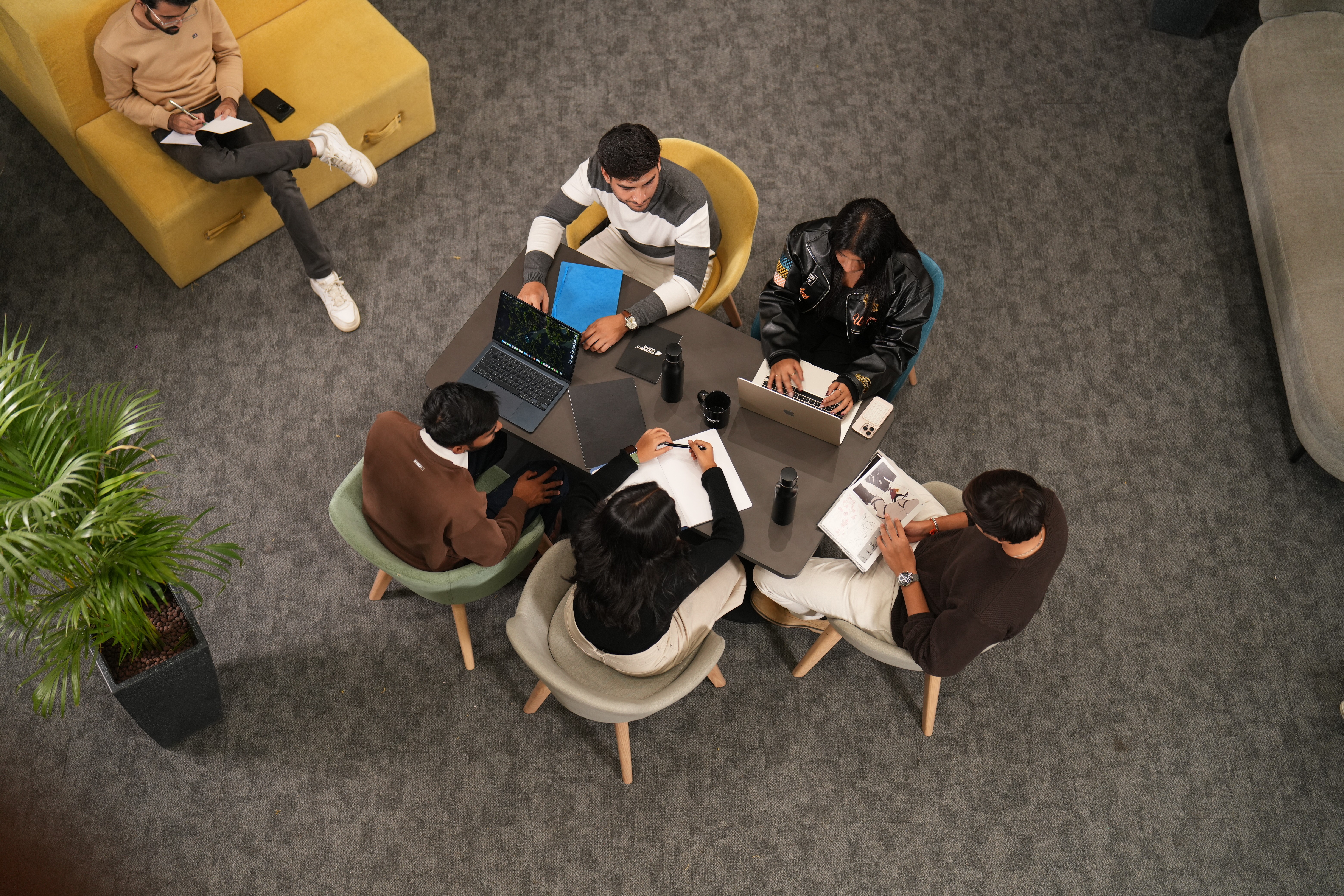
Interaction Design focuses on creating interactive experiences across screens, devices, and emerging digital platforms. Students master the intersection of user research, interaction design, and technical implementation to shape how humans engage with technology in meaningful ways.
Interaction
Industrial
Communication
Semester 5
Humanity-Centered Design
Intensive studio expanding beyond individual users to consider collective human flourishing, planetary boundaries, and systemic impact. Students learn participatory research methods that center marginalized voices; power mapping and stakeholder ecosystem analysis; identifying systemic inequalities and unintended consequences; framing challenges through justice and sustainability lenses; inclusive ideation with diverse communities; prototyping for collective benefit rather than individual optimization
Interaction Design Fundamentals
Technical foundation for digital interaction across platforms. Information architecture using card sorting and tree testing; wireframing from sketches to mid-fidelity; Gestalt principles and visual hierarchy; typography for interfaces; accessibility standards (WCAG 2.1 AA); Figma prototyping with components, variants, auto-layout; heuristic evaluation using Nielsen's principles; design system documentation. Covers both screen-based and emerging interfaces.
Programming for Designers
Essential coding skills for prototyping and collaboration. HTML/CSS for responsive layouts; JavaScript for interactivity and DOM manipulation; React basics for component-based interfaces; Git/GitHub for version control; API integration basics; evaluating technical feasibility; communicating with engineering teams. Students build functional prototypes of their designs.
Physical Computing and Tangible Interfaces
Introduction to IoT and embedded systems. Arduino programming for sensors and actuators; basic electronics and circuit design; sensor selection (IMU, pressure, proximity, biometric); tangible user interfaces blending physical and digital; IoT platforms (Particle.io, Arduino Cloud); wearable device prototyping; edge computing considerations. Foundation for both HCI and HMI tracks.
Design with AI and Machine Learning
Leveraging AI as design material and tool. Prompt engineering for generative AI; ML basics for designers; designing AI-powered features (recommendations, predictions); human-AI collaboration patterns; explainability and transparency; ethical AI design; bias detection and mitigation. Using tools like GPT, DALL-E, Runway in design workflow. Critical for modern practice.
Design Communication and Critique
Advanced skills in articulating and defending design decisions. Storytelling for design; presentation design and delivery; facilitating design critiques and workshops; visual documentation techniques; portfolio narrative development; writing design specifications; stakeholder management. Weekly critique sessions with industry guests.
Business of Digital Products
Understanding the ecosystem of digital product development. Product strategy and roadmapping; business models for SaaS and platforms; metrics and analytics (HEART framework, NPS); pricing strategies; go-to-market planning; venture design basics; intellectual property; startup ecosystem. Guest speakers from industry.
Semester 6
Advanced Design Studio
Complex, semester-long project with external client. Students choose HCI or HMI focus. HCI projects involve multi-platform services, AI integration, or social platforms. HMI projects focus on automotive interfaces, industrial controls, or medical devices. Full design cycle from research through high-fidelity prototypes.
HCI Track - Mobile and Web Development
Advanced implementation skills for digital products. React.js ecosystem; React Native for mobile; Node.js backends; progressive web apps; performance optimization; accessibility automation; design system implementation in code; deployment pipelines. Students build production-ready applications.
HMI Track - Automotive Interface Design
Specialized skills for in-vehicle systems. Driver attention and cognitive load; instrument cluster design; infotainment systems; Unity/Unreal for automotive prototyping; ISO and SAE safety standards; semi-autonomous vehicle interfaces (L2-L3); simulator-based testing; CAN bus basics. Industry partnerships with automotive companies.
Immersive and Spatial Design (AR/VR/XR)
Design for extended reality platforms. Spatial interface principles; Unity XR development; hand tracking and gesture design; comfort and motion sickness mitigation; spatial audio; cross-platform considerations (Quest, Vision Pro, HoloLens); use cases from training to entertainment. Both HCI and HMI applications explored.
Service Design and Systems Thinking
Holistic approach to complex service ecosystems. Journey mapping with emotional arcs; service blueprinting; stakeholder mapping; systems leverage points; multi-stakeholder co-design; business model canvas; service prototyping through role-play; implementation planning. Projects with real organizations.
Design Strategy and Innovation
Strategic thinking for designers. Competitive analysis and positioning; design-driven innovation; feature prioritization frameworks (RICE, MoSCoW); UX metrics and ROI; product requirement documents; design operations; pitching to executives; building innovation culture. Case studies from global companies.
Emerging Technologies Lab
Exploration of cutting-edge technologies. Topics rotate based on current innovations: brain-computer interfaces, quantum computing interfaces, blockchain/Web3 UX, synthetic biology interfaces, robotics collaboration, digital twins. Rapid prototyping sprints with new technologies.
Design Ethics and Futures
Critical perspectives on technology's impact. Value-sensitive design; privacy and surveillance; algorithmic bias; dark patterns; speculative design methods; design fiction; long-term thinking (10-50 years); sustainability in digital products; regulatory landscape (GDPR, AI Act). Preparation for responsible practice.
Foundations & Broad Exposure
These courses will be taken up by all design students, irrespective of their intended specialisation
Students will be exposed to the breadth of design, so they can take an informed decision on their specialisation in Year 2.
Semester 1
Foundation Drawing I
Develops fundamental observation and visual communication skills through intensive drawing practice. Students learn line quality, proportion, perspective, light/shadow, and various media techniques. Emphasis on drawing as a tool for seeing, thinking, and communicating design ideas across all disciplines.
Design Fundamentals I (2D/Color)
Introduces principles of two-dimensional design including composition, figure-ground relationships, visual hierarchy, and color theory. Students explore point, line, plane, texture, and pattern through analog and digital exercises. Develops sensitivity to visual relationships essential for all design streams.
Materials and Making I
Hands-on introduction to materials, tools, and fabrication processes. Students explore paper, cardboard, foam core, wire, and basic modeling materials while learning workshop safety and craft techniques. Develops material intelligence and three-dimensional thinking through rapid prototyping and iterative making.
Design History and Culture I
Surveys the evolution of design from pre-industrial craft traditions to early modernism, with special emphasis on Indian design heritage, craft clusters, and vernacular design. Examines the relationship between design, technology, society, and culture through global and local perspectives.
Design Process and Thinking
Introduction to design methodology, problem framing, and creative process. Students learn ideation techniques, mind mapping, concept development, and basic design research methods. Emphasizes iterative thinking, embracing ambiguity, and developing a designer's mindset.
Communication Skills I
Develops written, verbal, and visual communication abilities essential for designers. Focus on clear writing, presentation skills, critique participation, and visual documentation. Students learn to articulate design decisions, write project briefs, and present work professionally.
Semester 2
Foundation Drawing II
Advanced observational drawing with emphasis on figure drawing, spatial representation, and experimental mark-making. Introduces storyboarding, diagramming, and technical drawing basics. Students develop personal visual language and explore drawing as ideation tool for their emerging interests.
Design Fundamentals II (3D/Form)
Explores three-dimensional form, space, structure, and volume through physical and digital modeling. Students study proportion, scale, balance, and transformation while creating objects and spatial constructs. Introduces CAD basics and relationships between 2D and 3D representation.
Materials and Making II
Expanded material exploration including wood, metal, textiles, and plastics. Introduction to digital fabrication tools (laser cutting, 3D printing) and traditional craft techniques. Students complete cross-material projects that integrate multiple processes and consider sustainability.
Digital Tools Fundamentals
Essential digital literacy for designers covering Adobe Creative Suite (Photoshop, Illustrator, InDesign), basic CAD, and file management. Introduces digital photography, scanning, and output methods. Emphasizes software as tools for ideation and communication, not just execution.
Design History and Culture II
Continues chronological survey from modernism through contemporary practice, examining movements like Bauhaus, Ulm School, and postmodernism. Special focus on post-independence Indian design, global south perspectives, and emerging design practices in technology and sustainability.
Sustainability in Design
Introduction to ecological thinking, lifecycle analysis, and circular design principles. Students examine material choices, energy systems, and social sustainability through case studies and small projects. Addresses climate change, resource scarcity, and design's role in sustainable futures.